
Your cart
There are no more items in your cart
What is the Best Reverse Osmosis System for Home in 2026?
Tank or tankless, electric or non-electric, under-sink or countertop: the domestic reverse osmosis market has expanded considerably over the past two years. This guide honestly compares the four main types of home reverse osmosis systems available in France — their real advantages, their limitations, and which buyer profile each suits — so you can choose without making a costly mistake.
What all reverse osmosis systems have in common
Before comparing types, a baseline: all reverse osmosis systems share the same filtration principle. A semi-permeable membrane retains 95 to 99% of dissolved contaminants in the water — nitrates, pesticides, regulated PFAS, heavy metals, pharmaceutical residues, microplastics — and lets purified water through. It's the most comprehensive filtration technology available for domestic use, and it's the same regardless of brand or format.
What differentiates reverse osmosis systems is therefore how they deliver that filtered water — and that's where the choices have a real impact on your daily life, installation and long-term budget.
The four types of domestic reverse osmosis systems
1. Electric with storage tank
The most common format on the market. An electric pump forces water through the membrane, and filtered water is stored in a pressurised tank of 6 to 12 litres under the sink. Available immediately on demand — just open the dedicated tap.
Its main advantage is the lower entry price compared to tankless models. But the tank is its weak point: osmosis water sits between uses with no residual chlorine to protect it. Tankless systems are superior on this front — the bacterial risk from a storage tank is real, as stagnant water without chlorine can become a breeding ground for bacteria within days. The tank also takes up a significant portion of the under-sink space.
Best for: limited budget, moderate consumption, good local water quality.
2. Electric tankless (direct flow)
Tankless systems filter water in real time and deliver it straight to the tap, with no storage tank — this is the technology that has established itself as the premium standard in 2025-2026. Water is always fresh, never stored, and the under-sink footprint is reduced.
These models consume between 30 and 80 W when running and require a power outlet under the sink or nearby. Annual cartridge and membrane costs range from €50 to €100 depending on the model and incoming water quality — plus electricity consumption on top.
Best for: homeowners or renters with a power outlet available, high-consumption families, priority on freshness and hygiene.
3. Countertop (no installation)
Sits on the worktop with no plumbing connection. Tap water is poured manually into an upper tank, filtered through reverse osmosis, and stored in a lower tank. No installation, no drilling — ideal for renters.
Main constraint: you need to remember to refill the tank regularly, and capacity is limited. Not suited to a household consuming more than 5 to 8 litres of filtered water per day.
Best for: renters, small households, occasional or transitional use.
4. Non-electric (mains pressure)
The least well-known format, yet the one that best suits certain specific profiles. No pump, no electrical connection: the natural pressure of the water network (from 1.5 bar) drives the water through the membrane. The result: zero energy consumption, no noise, no power outlet required.
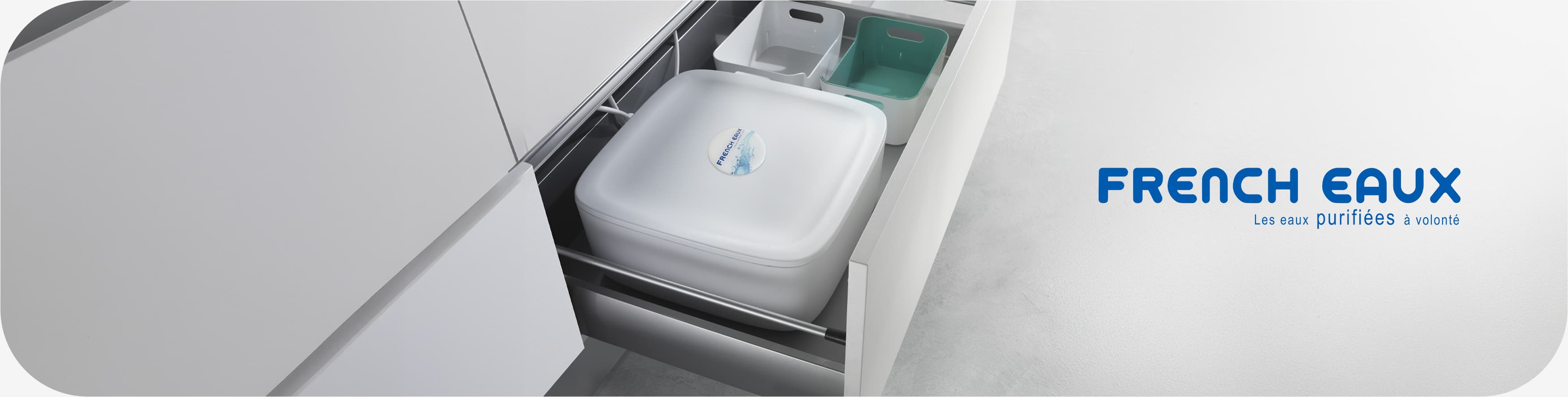
The OneZero French Eaux is the only non-electric reverse osmosis system available in France designed for domestic and nautical use. It produces 15 L/h, filters up to 7,000 litres per cartridge set (€95 annual replacement cost, or €0.014 per litre filtered), and installs under the sink with no electrical work required.
Its limitation compared to electric tankless models: flow rate is lower (15 L/h vs 60-120 L/h for premium electric models). For a family of four consuming 8 to 10 litres of filtered water per day, it's more than sufficient. For intensive or professional use, an electric tankless model is more appropriate.
Best for: households without a power outlet under the sink, holiday homes, boats and off-grid environments, consumers who want zero energy spend, renters unable to add electrical installations.
Comparison of the four types at a glance
| Electric + tank | Electric tankless | Countertop | Non-electric (OneZero) | |
|---|---|---|---|---|
| Electricity required | Yes | Yes | No | No |
| Standing water risk | Yes (tank) | No | Yes (tank) | No |
| Flow rate | Moderate | High (60-120 L/h) | Low | 15 L/h |
| Installation | Plumbing + electrical | Plumbing + electrical | None | Plumbing only |
| Noise level | Audible pump | Audible pump | Silent | Silent |
| Annual consumable cost | €50 – €100 | €50 – €100 | Variable | €95 / 7,000 L |
| Cost per litre filtered | €0.01 – €0.03 | €0.01 – €0.03 | Variable | €0.014 |
Which reverse osmosis system for your situation?
You own your home, have a power outlet under the sink, and have a family of four or more: an electric tankless system is the most comfortable choice — high flow rate, fresh water, no tank. Higher upfront cost but the best day-to-day experience.
You're renting with no power outlet available under the sink: the non-electric system (OneZero) is the most suitable option. Installation is limited to connecting to the cold water inlet — no electrical work, no structural modification to the property.
You have a holiday home, chalet or boat where electricity is limited: this is exactly the OneZero's territory — designed to run on mains water pressure alone, without depending on a permanent electrical installation.
Your budget is tight and you're looking for an entry-level option: an electric system with a storage tank is the cheapest to buy. Factor in cartridge costs over 3 to 5 years to compare the true total cost, not just the purchase price.
The non-electric reverse osmosis system by French Eaux
The OneZero French Eaux is the only non-electric reverse osmosis system designed for domestic and nautical use — 15 L/h, 7,000 litres per cartridge set, installation with no electrical constraint.
Frequently asked questions
Does a non-electric reverse osmosis system filter as well as an electric one?
Yes. Filtration quality depends on the reverse osmosis membrane, not on whether a pump is present. The OneZero uses the same membrane technology as electric models — it removes up to 99.9% of dissolved contaminants. The difference is in flow rate (15 L/h vs 60-120 L/h for premium electric models), not in the quality of the water produced.
Does reverse osmosis water need to be remineralised?
Reverse osmosis removes natural minerals from the water along with contaminants. This isn't dangerous — a normal diet easily covers calcium and magnesium needs. For those who prefer water with a rounder taste, a remineralisation cartridge can be added downstream of the system.
What minimum water pressure does a non-electric system need?
The OneZero requires a minimum of 2 bar, which is the standard mains pressure in France. The operating range is 1.5 to 6 bar. Below 1.5 bar (rare, generally at altitude or with very old networks), an electric model with a booster pump is preferable.
What is the real cost of a reverse osmosis system over 3 years?
For the OneZero: cartridges at €95/year × 3 years = €285 in consumables over 3 years, zero electricity. For an electric tankless model: €50 to €100/year in cartridges plus electricity consumption (around 30-80 W when running). Over 3 years, costs are comparable — the main difference is in the initial purchase price and the electrical constraint.
Does a reverse osmosis system treat all the water in the house?
No — a reverse osmosis system treats drinking water at the point of use (kitchen tap). It doesn't treat shower water, washing machine water or the water heater. For whole-house water treatment against limescale, a water softener is complementary — the two install in parallel and address different needs.
