
Your cart
There are no more items in your cart
PFAS in Tap Water: What You Need to Know
Since January 2026, testing for PFAS in tap water has become mandatory across all French distribution networks. The first results confirm a contamination far more widespread than previous monitoring suggested. This guide explains what PFAS are, what risks they pose, and which filtration solutions actually work.
What are PFAS, the "forever chemicals"?
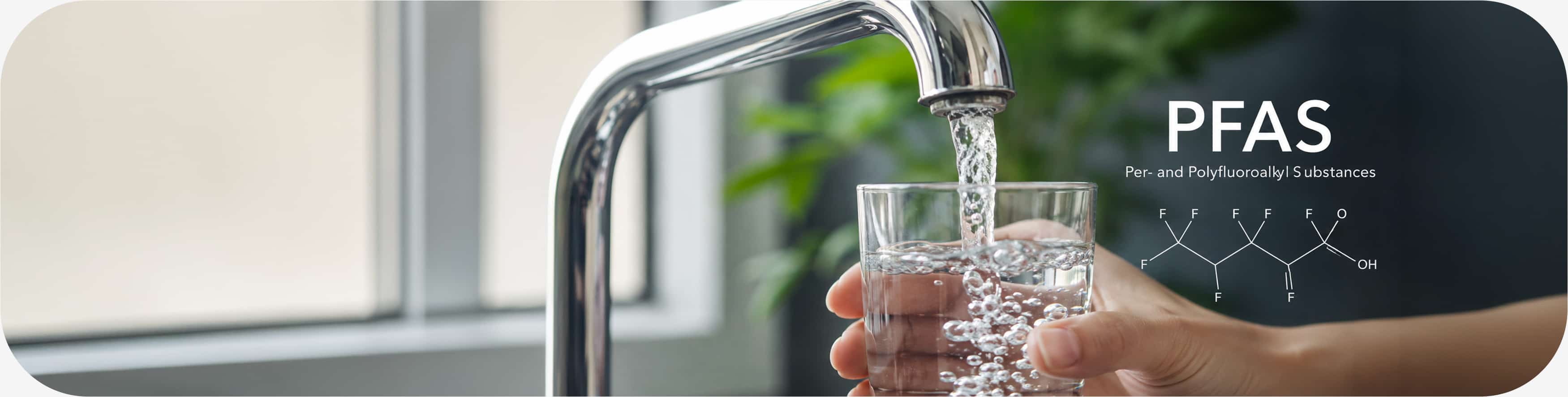
PFAS (per- and polyfluoroalkyl substances) refer to a family of over 12,000 synthetic chemical molecules developed since the 1940s. What they share: an extremely stable carbon-fluorine bond that makes them virtually indestructible in the environment — hence the nickname "forever chemicals".
They're found in everyday products: non-stick cookware coatings, grease- resistant food packaging, waterproof textiles (Gore-Tex), firefighting foams used at airports and military bases, cosmetics. Once released into the environment, they migrate through soil into groundwater and, ultimately, into drinking water networks.
They're invisible, odourless, and unaffected by boiling. Conventional water treatment plants don't remove them either.
What is the situation in France in 2026?
Since 1 January 2026, in accordance with European directive 2020/2184, monitoring for 20 PFAS in drinking water has become mandatory across all French distribution networks. The regulatory limit is set at 0.1 µg/L (100 ng/L) for the sum of these 20 substances.
Of the 8,827 networks that have already been tested, 24 exceed this regulatory limit — 0.3% of networks analysed. The most concerning situations are in the Ardennes (where water consumption was banned in around a dozen municipalities), the Meuse, and certain areas around Lyon near chemical industrial sites.
These figures seem reassuring. But they conceal a more complex reality around one particular PFAS: TFA.

TFA: the forgotten PFAS contaminating 92% of French water
TFA (trifluoroacetic acid) is an ultra-short chain PFAS produced mainly from the breakdown of hydrofluorocarbon (HFC) refrigerant gases used since the 1980s, and from certain fluorinated pesticides. Its defining characteristics: it is extremely water-soluble, highly mobile through soil, and resistant to conventional water treatment methods.
Between 2023 and 2025, the Anses (French food, environmental and occupational health and safety agency) conducted a national survey of 647 samples of distributed water. The result: 92% of samples contained TFA, with a median concentration of 780 nanograms per litre. In Paris (10th arrondissement), analyses by UFC-Que Choisir and Générations Futures recorded concentrations of up to 6,200 ng/L.
The problem: TFA is not yet part of the 20 PFAS under official regulatory surveillance. Its integration into the sanitary control programme is not planned until January 2027 (decree of 22 December 2025). In 2026, your tap water may contain TFA at significant levels without this appearing in any official water quality report.
The health risks associated with TFA are still being studied — Anses has specific ongoing work on this subject. Germany, which analysed it earlier, has proposed classifying it as toxic for reproduction and set an indicative safety guidance value of 60 µg/L. Studies suggest potential effects on the liver and endocrine system, but evidence in humans is still being consolidated.
What are the health risks of PFAS in water?
For the 20 regulated PFAS, the scientific evidence is more established. The US National Academies of Sciences (NASEM, 2022) identified four effects with sufficient evidence linked to chronic exposure: increased LDL cholesterol, reduced vaccine response in children, increased risk of certain cancers (kidney, testicular), and thyroid disorders. The International Agency for Research on Cancer (IARC) classified PFOA as a definite human carcinogen in 2023.
These effects are associated with long-term chronic exposure, not a single glass of water. The populations most at risk are infants (bottle preparation), pregnant and breastfeeding women, and people living in areas with elevated contamination.
It's important not to confuse the presence of PFAS in water with an immediate danger: in the vast majority of French cases, measured concentrations are well below regulatory thresholds for the 20 monitored PFAS. The real concern is cumulative exposure over years, and the unresolved question of unregulated TFA.
How to check if your water is affected
Three reliable, free sources to check the water quality in your area:
dansmoneau.fr — the most comprehensive tool, launched in October 2025 by Générations Futures and Data for Good. Searchable address by address, it displays results for five pollutant categories: PFAS, pesticides, nitrates, perchlorate and vinyl chloride monomer. Updated monthly.
sante.gouv.fr — the French Ministry of Health's official website allows you to consult sanitary control results municipality by municipality. Data is raw but exhaustive and officially authoritative.
Your annual water quality report — sent with your water bill or available from your local town hall. It lists the parameters analysed on your network for the previous year.
One important limitation: none of these tools currently includes TFA data, since it won't be part of official regulatory monitoring before 2027. TFA contamination is invisible in current official tools, regardless of your municipality.
Which filtration solutions actually work against PFAS?
Not all domestic filtration technologies perform equally against PFAS. Here is an honest assessment based on available data.
Activated carbon filter jugs: according to a study published in Environmental Science & Technology Letters (Duke University, 2020), activated carbon jugs retain on average around 50% of PFAS, with significant variation depending on the molecules and cartridges. On long-chain PFAS (PFOS, PFOA), the best Brita cartridges reach up to 96% according to Test-Achats. But on short-chain PFAS and TFA, effectiveness is very limited.
Under-sink granular activated carbon filters: more effective than jugs on certain long-chain PFAS, but with the same limitation on ultra-short molecules. Performance varies significantly by filter certification (NSF/ANSI 58 or 53).
Reverse osmosis: the most effective solution currently available for domestic PFAS filtration. Reverse osmosis removes 96 to 99% of regulated PFAS, including the short-chain PFAS that activated carbon fails to retain. Its membrane filters at 0.0001 µm — a scale at which virtually all pollutant molecules are stopped.
An important transparency note: for TFA specifically, no mainstream domestic filter currently certifies complete and reliable elimination. Anses research on this is ongoing. Reverse osmosis remains the closest thing to an effective solution on TFA among currently available domestic technologies, but specific certifications are still pending.
What not to do: boiling water does not destroy PFAS. It evaporates the water, concentrating the remaining dissolved molecules. Standard filter jugs without specific anti-PFAS certification offer only partial protection.
Which solution is right for your household?
If you want to reduce your exposure to PFAS in tap water, reverse osmosis remains the most effective domestic filtration technology currently available.
Frequently asked questions
My water is compliant with standards — should I still be concerned about PFAS?
Regulatory compliance covers the 20 PFAS under official surveillance. It says nothing about TFA, which is not yet in the sanitary monitoring system and was found in 92% of French water samples according to Anses. Being compliant on the 20 regulated PFAS does not guarantee the absence of TFA in your water.
Does boiling water remove PFAS?
No. Boiling does not degrade PFAS. It only evaporates the water, which concentrates the remaining dissolved pollutants. This is the most common mistake people make when faced with this type of contamination.
Are PFAS dangerous for infants?
Infants are among the most vulnerable groups, primarily because of bottle preparation using tap water. For households in areas with detected or elevated contamination, reverse osmosis filtration is the most justified precaution for bottle preparation.
Can I check my water's PFAS levels for free?
Yes, via dansmoneau.fr (address by address, updated monthly) or sante.gouv.fr (official ARS results). Neither tool currently covers TFA, which will be integrated into the official monitoring programme in January 2027.
Does reverse osmosis remove all PFAS?
It removes 96 to 99% of regulated PFAS. On TFA specifically, no mainstream consumer certification is yet available, but reverse osmosis remains the most effective technology among currently available domestic solutions.
