
Your cart
There are no more items in your cart
Home Water Softener – DOMADOU 1 French Eaux
Limescale in the kettle, white residue on taps, household appliances wearing out faster than they should: hard water is one of the most common issues in homes across France. The DOMADOU 1 French Eaux is a compact water softener that runs without electricity, with smart regeneration that cuts salt consumption by up to 40% compared to a standard softener.
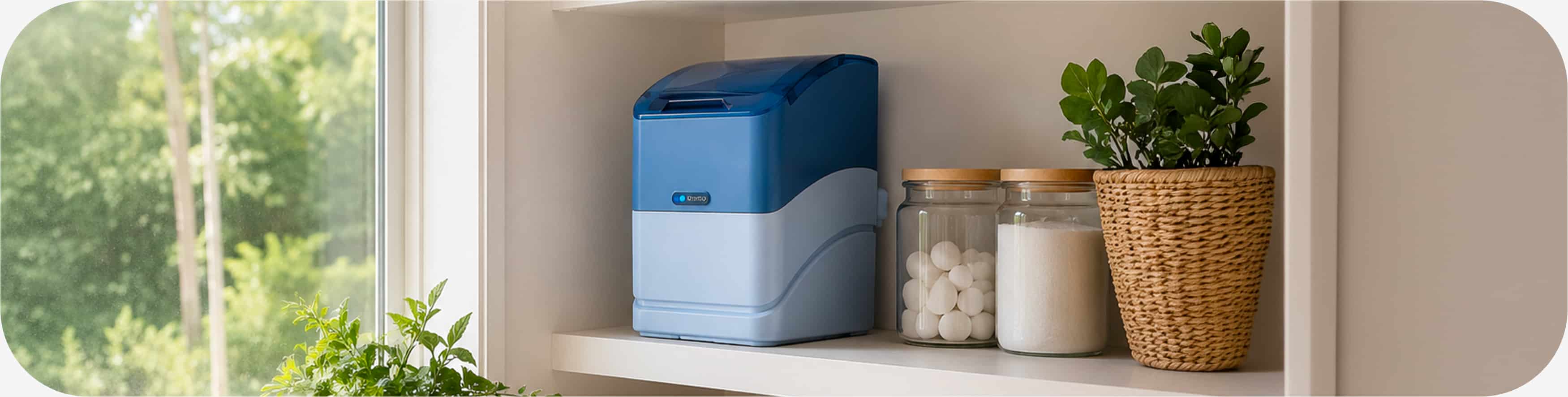
Limescale: a quiet but costly problem
Large parts of France have what's known as "hard" water — rich in calcium and magnesium. Day to day, that shows up as white residue on taps and dishes, skin that feels tight after a shower, rougher laundry, and most importantly, faster wear on household equipment: water heaters, washing machines, dishwashers, kettles. Limescale builds up inside these appliances, reducing their efficiency and cutting years off their lifespan.
Many households turn to a water softener as a result. But standard models often come with two issues: a permanent electrical connection that adds an installation constraint, and salt consumption that can quickly become a recurring expense if the unit regenerates more often than the household actually needs.
The DOMADOU 1 addresses both at once.
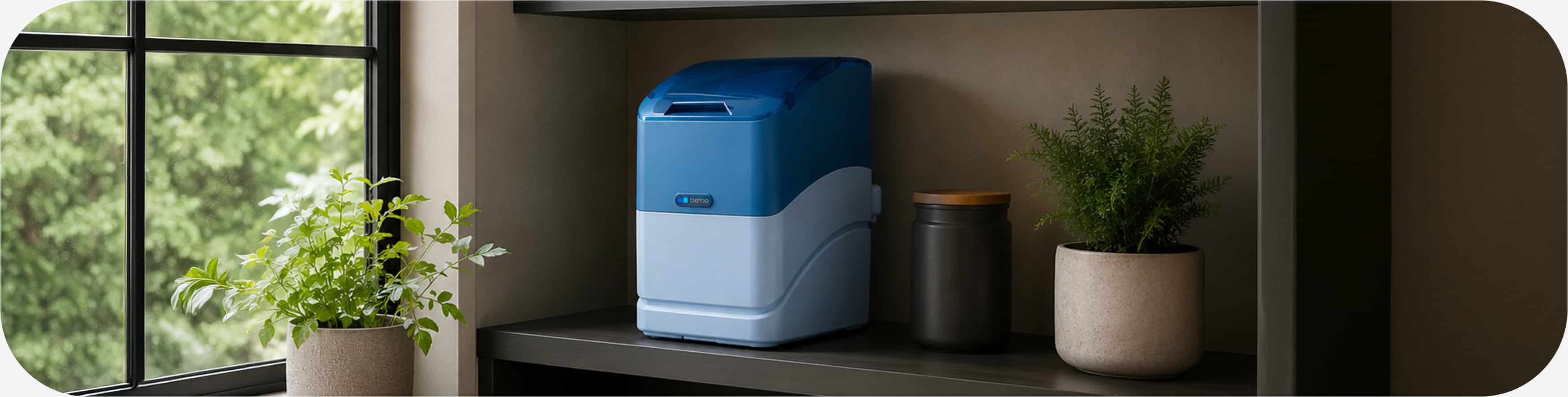
What does a non-electric softener actually change?
The DOMADOU 1 runs solely on mains water pressure — no electrical outlet is required for it to function. That simplifies installation (no need to plan around an electrical socket), removes any power consumption, and makes the unit more reliable over time: fewer electronic components, fewer potential failure points.
Its volumetric counter-current regeneration technology is the second key advantage. Unlike a standard softener that regenerates on a fixed cycle (often overnight, whether it's actually needed or not), the DOMADOU 1 only regenerates once its real treatment capacity is reached — based on the household's actual water usage. The result: salt consumption reduced by up to 40% compared to a standard softener, and softened water available exactly when the household needs it.
Compact by design, it installs easily in a laundry room, garage, technical room or utility cabinet. Available in two versions to match different household needs: a 1.8 m³/h model, ideal for 4 to 5 water points, and a 2.1 m³/h model for higher-consumption households.
DOMADOU 1 vs standard electric water softener
| DOMADOU 1 | Standard electric softener | |
|---|---|---|
| Electrical connection | Not required | Yes (mains outlet needed) |
| Regeneration | Volumetric, based on actual use | Often fixed cycle |
| Salt consumption | Up to 40% lower | Standard reference |
| Long-term reliability | Fewer electronic components | Circuit board, sensors |
| Noise level | Silent | Audible regeneration cycle |
| Installation | No electrical constraint | Requires a nearby outlet |
Salt-free alternatives also exist on the market (ionisation, electrostatic treatment). They avoid adding salt but rely on different technologies, with their own trade-offs in effectiveness on very hard water. The DOMADOU 1 is built on ion-exchange resin — the most proven technology for real, measurable softening — while significantly cutting salt use compared to standard models.
Technical specifications
| Operation | Non-electric |
| Regeneration | Volumetric counter-current |
| Flow rate (small model) | 1.8 m³/h |
| Flow rate (large model) | 2.1 m³/h |
| Dimensions (small model) | 293 × 500 × 508 mm |
| Dimensions (large model) | 297 × 500 × 608 mm |
| Colour | Blue |
| Warranty | 2 years |
Discover the DOMADOU 1 French Eaux
A compact, non-electric water softener with smart regeneration that cuts salt consumption by up to 40%.
Frequently asked questions
Does the DOMADOU 1 really work without electricity?
Yes. It runs solely on mains water pressure. No electrical outlet is needed for it to function or for its regeneration cycles.
Does the DOMADOU 1 use salt?
Yes, like all ion-exchange resin softeners — this is the technology that guarantees real, measurable softening. What sets the DOMADOU 1 apart is its smart volumetric regeneration, which cuts salt consumption by up to 40% compared to a standard softener by only regenerating when actually needed.
Which model should I choose for my household?
The 1.8 m³/h model suits a household with 4 to 5 water points. The 2.1 m³/h model is recommended for households with higher water consumption or more water points to cover.
Where can the DOMADOU 1 be installed in the home?
Thanks to its compact footprint, it installs easily in a laundry room, garage, technical room or utility cabinet, close to the home's main water inlet.
What maintenance does it require?
Maintenance mainly involves regularly refilling the salt tank. Frequency depends on the household's water consumption and local water hardness.
